
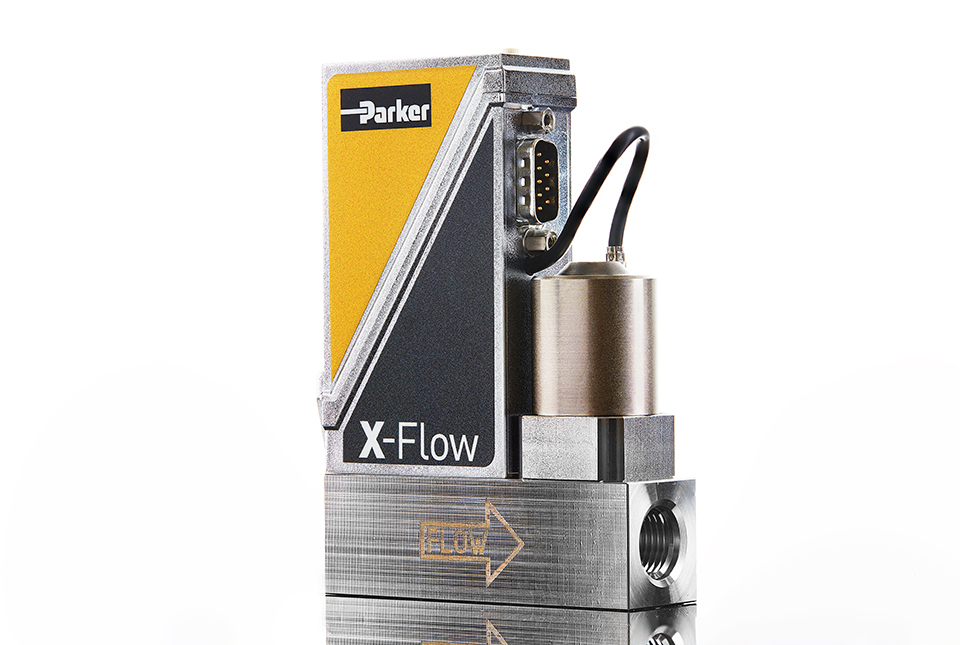
Over the course of several assignments, I’ve had the opportunity to photograph a wide range of products for Parker Hannifin’s Precision Fluidics division, including pumps, regulators, and flow controllers.
When our work together began, Parker did not have professional photographs of many of these products. In some cases, there were no usable images at all. They needed a versatile collection of photographs for their website, product data sheets, and other marketing materials.
What developed was not simply a series of individual product shoots, but a growing and consistent visual library representing the breadth of Parker’s fluidics product line.
Photographing an Entire Product Line
Every Parker assignment has been a little different. Some products required several individual angles, while others called for group photographs or closer views highlighting a particular control, connection, or feature.
Although the products varied in size and configuration, the finished images needed to feel as though they belonged together. Consistent lighting, camera angles, backgrounds, and overall image quality were important because the photographs would often appear alongside one another on the website and in technical materials.
That consistency is one of the most important aspects of photographing a large product line. Each image needs to work on its own, but it also needs to support the visual identity of the complete collection.
Small Products With Important Details
Parker’s fluidics products are generally small, but they contain a great deal of visual information. Labels, fittings, controls, connectors, and subtle differences between models all need to be represented clearly.
I used a 100mm macro lens to capture those smaller details while maintaining a natural-looking perspective. Soft, diffused lighting helped define the shape and materials of each product without introducing harsh reflections or shadows that could obscure important features.
The goal was to make the products look polished while remaining completely accurate. For technical customers, an attractive photograph is not enough—the image also needs to help them understand what they are looking at.
Keeping Everything Sharp With Focus Stacking
Working at close range introduces another challenge: depth of field becomes extremely shallow. A single exposure might render the front of a product sharply while allowing connectors, labels, or controls farther back to fall out of focus.
For many of the Parker photographs, I used focus stacking to overcome that limitation. I created a series of exposures focused at different points across the product and combined them into one finished image with sharp detail from front to back.
Focus stacking takes additional time, but it makes a significant difference when photographing small technical products. The viewer can examine the complete product rather than seeing only one narrow area in focus.
I also photographed every product while tethered to a computer. Reviewing each exposure on a large monitor allowed me to inspect intricate details, verify focus, spot unwanted reflections, and make small adjustments before moving on to the next view.
When the products themselves are small, those details can be easy to miss on the back of a camera. Tethered review gives me the confidence that the images will hold up when viewed at full resolution or placed in a product data sheet.
Working From a Detailed Client Brief
Parker representatives did not need to be present in the studio during the shoots. Instead, they provided detailed instructions identifying the products, requested angles, groupings, and features that needed to be shown.
That direction gave me a clear understanding of what each photograph needed to accomplish while allowing the work to proceed efficiently in the studio.
This arrangement can be especially convenient for industrial and technical clients. Products can be delivered or shipped to the studio with a well-defined shot list, photographed independently, and returned once the required images are complete.
A Growing Library of Finished Images
Across the different assignments, I delivered approximately 50–100 fully edited, high-resolution JPEG images. Every product also received a clipping path, making it easier for Parker’s designers to separate it from the background and incorporate it into webpages, data sheets, presentations, and other layouts.
The completed photography has been used extensively throughout Parker’s website and is available for its wider print and digital marketing needs.
Parker was very happy with the results, and the multiple assignments allowed us to build a substantial image library that is both technically accurate and visually consistent.
Product Photography for Technical and Industrial Companies
Technical product photography is about more than producing a clean photograph on a white background. It requires understanding which features matter, controlling light on small and complex surfaces, and ensuring that every important detail remains sharp and visible.
Mark Mendoza Photography provides professional product photography for manufacturers, engineering firms, medical-device companies, and other B2B organizations throughout Greater Boston and New England.
If your company needs consistent, detailed photography for a single product or a complete product line, contact Mark Mendoza Photography to discuss your project.